Amélie Esterházy "in uno omnia"
VARIOUS OTHERS SAISON OPENING
Amélie Esterházy
in uno omnia
Exhibition period: 17.09.-31.10.2026
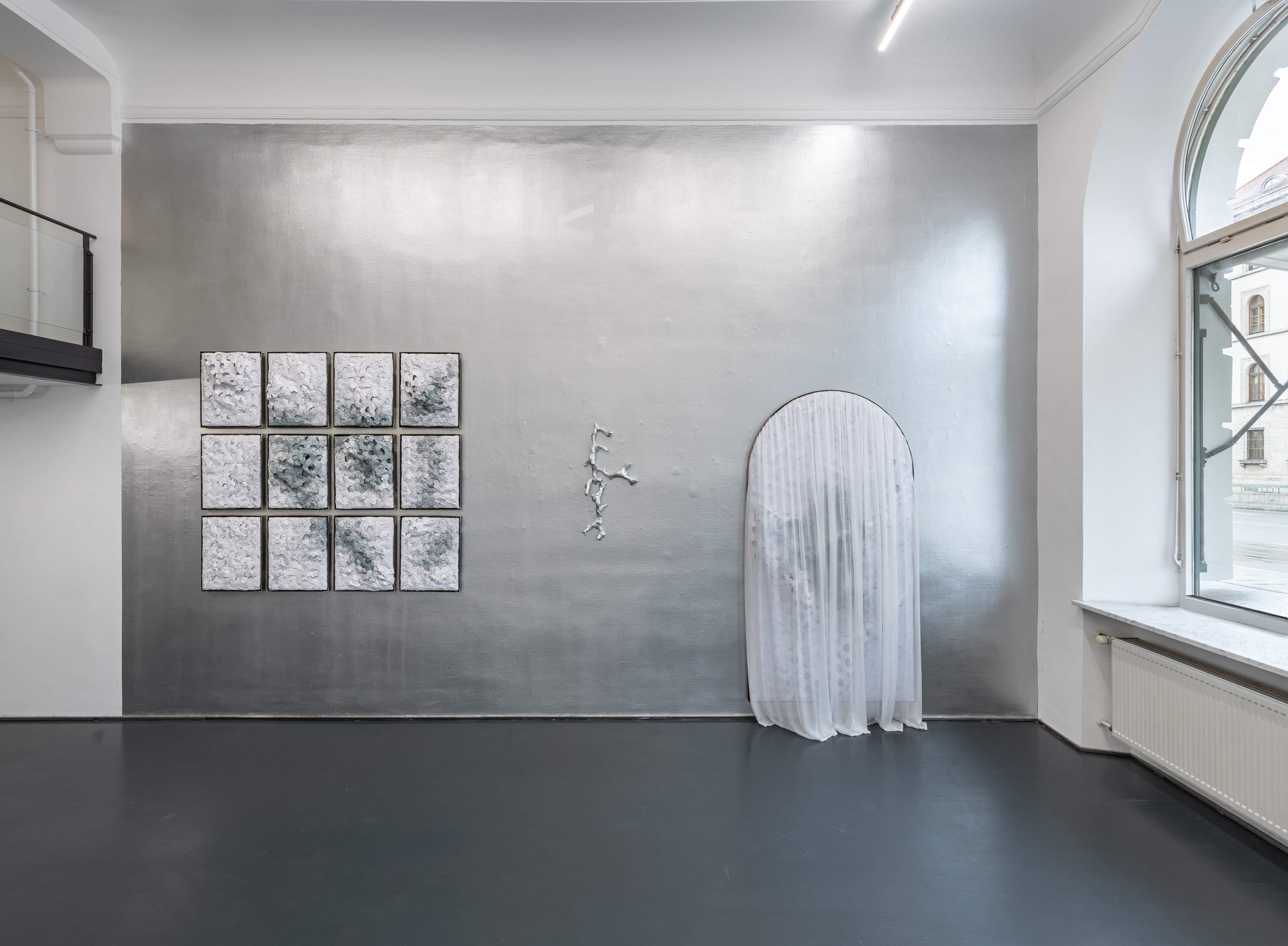
In in uno omnia, Amélie Esterházy continues her exploration of the models through which people attempt to find their bearings in a complex world. Rather than presenting maps, diagrams, cosmological systems and scientific classifications as neutral representations, she shows them to be attempts to establish connections and develop a conception of the whole from individual observations.
The title in uno omnia – meaning 'all in one' – comes from the polymath Athanasius Kircher (1602–1680) and refers to the idea that diverse fields of knowledge can be linked within an overarching context. At the same time, it embodies the aspiration to grasp the whole from an abundance of individual parts. The exhibition takes up this idea without imposing a fixed order: structures overlap, break down, repeat and reassemble.
Kircher's endeavour to gather, organise and interlink knowledge within universal systems serves as a historical point of reference. His maps and diagrams linked the cosmos, nature, language and the body, based on the idea that a unified whole could be derived from the wealth of knowledge. However, the vast quantity of information did not necessarily lead to insight, and Kircher frequently drew speculative or erroneous conclusions from his observations. This is precisely why his thinking is surprisingly relevant today: having access to knowledge and organising it does not necessarily mean that one can draw the correct conclusions from it.
In the figure of Maria Knotenlöserin, knowledge is presented as something that cannot be understood in an abstract sense. The female saint confronts the knot, which symbolises a complex problem that initially seems insoluble, with her hands. Understanding and solving become physical, tactile processes involving touching, tracing, unravelling and reordering. Alongside maps, diagrams, collections and universal systems of knowledge, this gives rise to an alternative form of orientation which does not survey connections from a distance, but rather approaches them directly.
In a present-day world of virtually unlimited information, these diverse historical, abstract and physical forms of organisation and cognition take on a new dimension. Algorithmic systems and artificial intelligence can process vast amounts of information.
In the present day, which is characterised by an almost unlimited supply of information, these diverse historical, abstract and physical forms of organisation and cognition take on a new dimension. Algorithmic systems and artificial intelligence can capture, organise and link vast amounts of knowledge. Thus, Kircher’s vision of a universal system of knowledge emerges again in a new context, along with the question of its limits. While artificial intelligence is not the subject of the exhibition, it provides a contemporary context for a question that runs through the works: does the availability of ever-increasing amounts of knowledge actually lead to greater insight and understanding?
-1-2333x3500.jpg)
-2269x3500.jpg)
.jpg)
-1-2333x2287.jpg)
-2333x3500.jpg)
.jpg)
.jpg)
-2358x3500.jpg)
-1.jpg)
.jpg)
-2.jpg)
.jpg)
.jpg)
Dirk Tacke